






 Back
BackApplications, News, Education
ANTERIOR CRUCIATE LIGAMENT (ACL) RECONSTRUCTION: WHICH GRAFT AND WHICH TECHNIQUE IS OPTIMAL?
Anterior Cruciate Ligament (ACL) Reconstruction: Which Graft And Which Technique Is Optimal?
Tái Tạo Dây Chằng Chéo Trước (ACL): Nên Chọn Mảnh Ghép Nào Và Kỹ Thuật Nào Tối Ưu?
English Version | Bản tiếng Việt bên dưới.
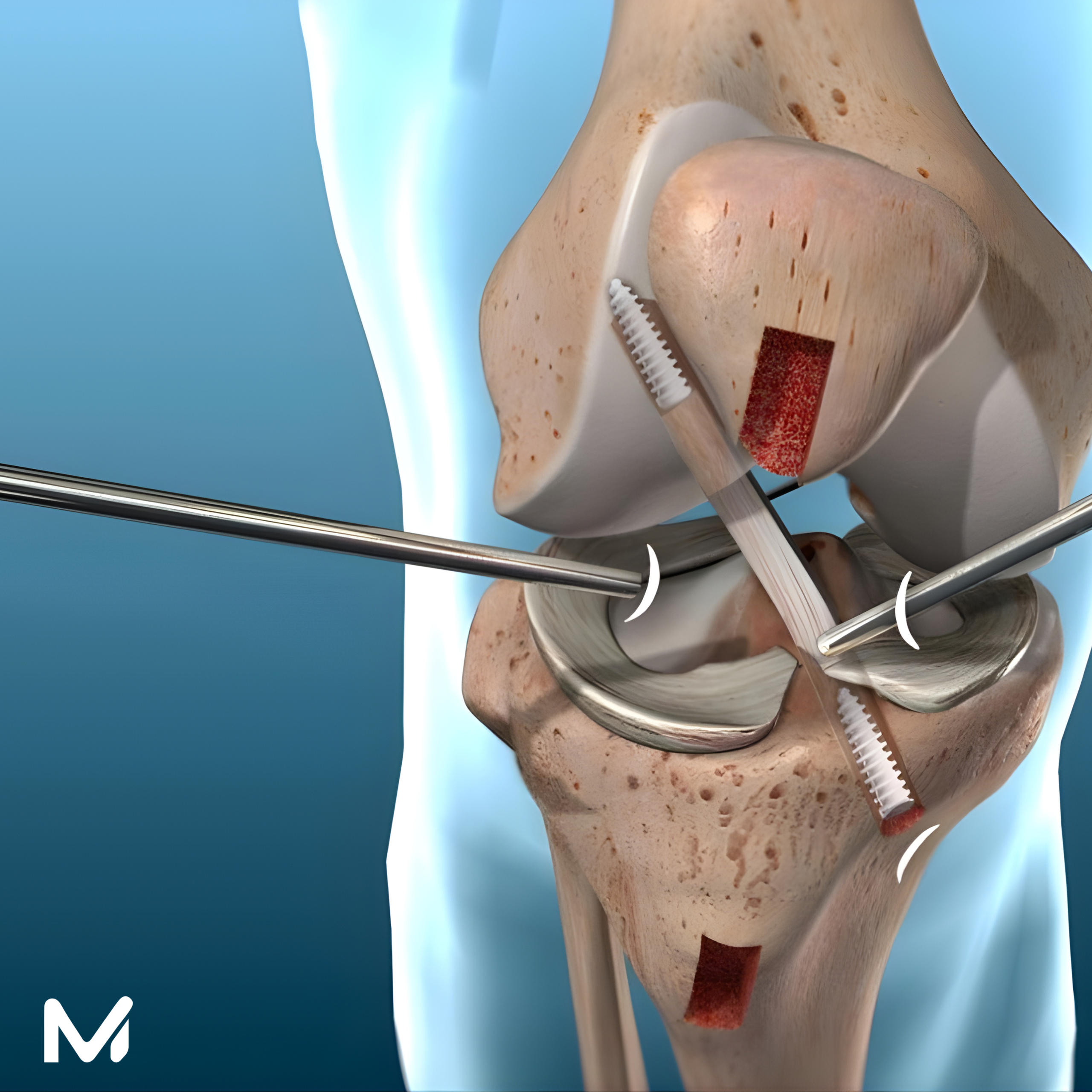
1. ACL Reconstruction: Success Goes Beyond the Operation
Anterior cruciate ligament (ACL) rupture is a common injury among athletes and physically active individuals. In surgical management, the goal is not only to reconstruct the ligament but also to restore knee stability, functional performance, return-to-sport capability, and reduce the long-term risk of re-rupture.
A 2024 review highlights that ACL reconstruction outcomes depend on multiple factors, including graft selection, surgical technique, tunnel placement, fixation method, and postoperative rehabilitation protocols (Gharpinde, Jaiswal, & Dhanwani, 2024).
2. Graft Options in ACL Reconstruction
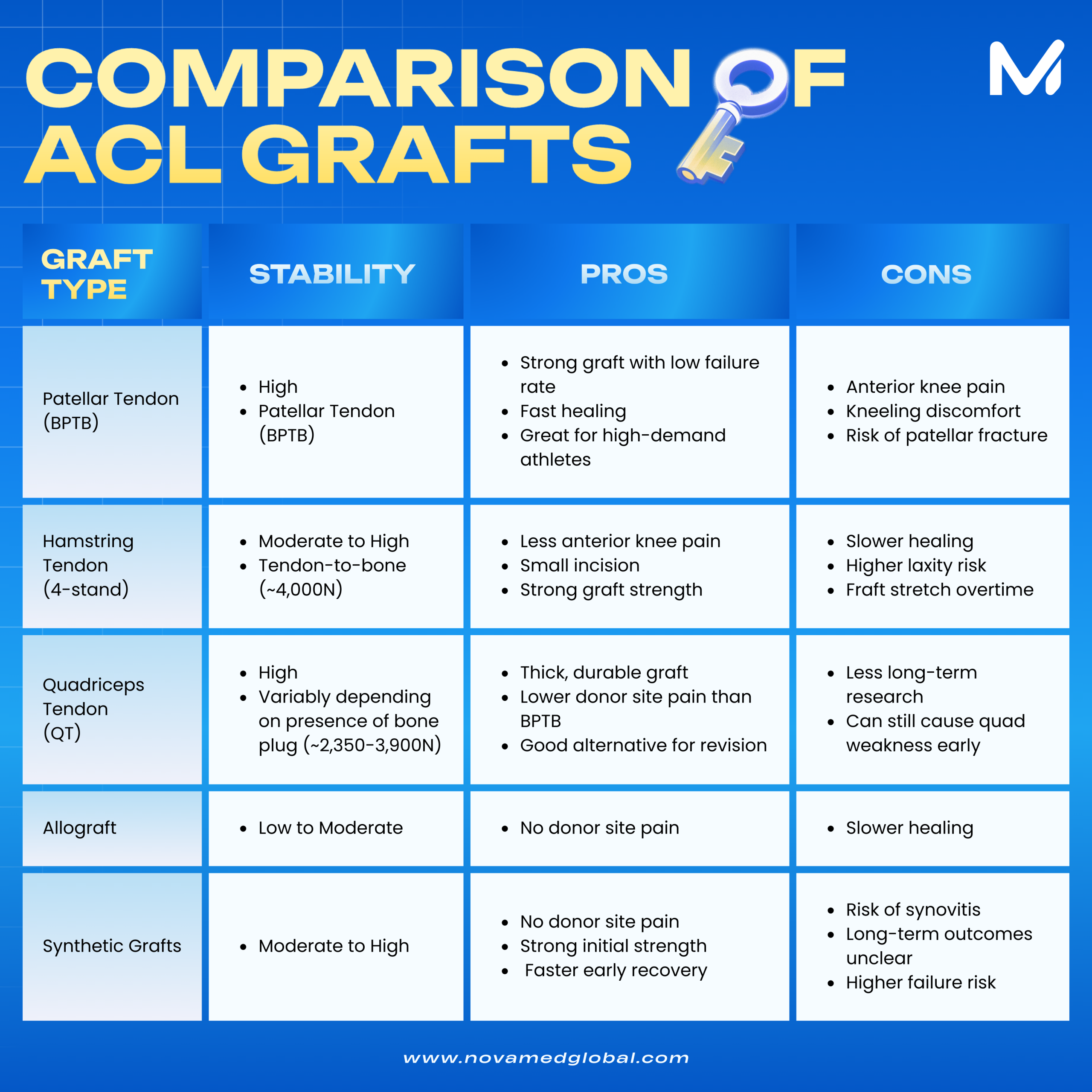
Currently, the main graft categories include autografts, allografts, and synthetic grafts. Among these, autografts remain the cornerstone in most primary ACL reconstructions due to superior biological incorporation and more reliable mechanical properties.
The review also emphasizes that graft selection should be individualized based on patient age, activity level, sporting demands, and risk of reinjury.
2.1 Bone-Patellar Tendon-Bone (BPTB) Autograft
The bone-patellar tendon-bone graft offers the advantage of rapid bone-to-bone healing and strong fixation, and has long been considered a mechanically robust option.
However, common drawbacks include anterior knee pain, kneeling discomfort, donor-site morbidity, and potential patellar tendon-related complications. Therefore, it is often preferred in patients requiring high stability but should be used cautiously in individuals who frequently kneel or have pre-existing anterior knee pain.
2.2 Hamstring Tendon Autograft
Hamstring tendon autografts are widely used due to reduced anterior knee pain and less morbidity at the anterior knee compared to BPTB grafts.
Limitations include potentially slower graft incorporation compared to bone-to-bone healing and possible weakness of the harvested hamstring muscles in some patients. Nevertheless, this option remains popular due to its balanced profile between stability, function, and postoperative comfort.
2.3 Quadriceps Tendon Autograft
Quadriceps tendon grafts are gaining increasing attention as they provide a large and robust graft, representing a potential middle-ground option between BPTB and hamstring grafts.
Many authors consider this an attractive alternative, particularly when a larger graft diameter is needed or when avoiding certain disadvantages of BPTB and hamstring grafts. However, long-term outcome data remain less extensive compared to traditional graft choices.
2.4 Allograft
Allografts offer advantages such as the absence of donor-site morbidity, shorter operative time, and generally more comfortable postoperative recovery.
However, major limitations include slower biological incorporation and a higher risk of graft failure or re-rupture, particularly in younger and highly active patients. Therefore, allografts are typically more suitable for older individuals, those with lower activity demands, or in selected clinical indications.
2.5 Synthetic Grafts
Synthetic grafts, such as LARS, have attracted attention due to the potential for early recovery and avoidance of autograft harvesting.
However, long-term outcomes remain less consistent compared to biological grafts, with concerns regarding durability, tissue integration, and long-term complications. As a result, biological grafts remain the primary choice in most primary ACL reconstructions.
3. Surgical Technique: Single-Bundle or Double-Bundle?
Single-bundle reconstruction remains the standard technique due to its relative simplicity, shorter operative time, and strong long-term outcome data.
Double-bundle techniques were developed to better replicate native ACL anatomy by reconstructing both functional bundles, with the potential to improve rotational stability.
However, clinical benefits are not consistently superior enough to justify routine use in all patients. Therefore, technique selection should be based on individual anatomy, degree of rotational instability, surgeon experience, and patient activity goals.
4. Anatomical Tunnel Placement: A Decisive Factor
One of the most important messages from the review is that accurate anatomical tunnel placement has a significant impact on ACL reconstruction outcomes.
Proper tunnel positioning helps restore near-physiological knee kinematics, improving stability and function. In contrast, non-anatomical tunnel placement may lead to residual laxity, reduced graft effectiveness, and increased risk of failure.
This is why modern surgical approaches increasingly emphasize anatomical reconstruction rather than purely structural replacement.
5. Graft Fixation: No Universal Solution
Common fixation methods include interference screws and cortical button devices. Each technique has specific advantages depending on graft type, tunnel configuration, and surgical approach.
The current perspective is not to identify a universally “best” method, but to select the most appropriate fixation strategy for each individual clinical scenario.
6. Postoperative Rehabilitation: An Integral Component of Success
ACL reconstruction does not end in the operating room. Rehabilitation plays a critical role in reducing swelling, restoring full knee extension, rebuilding quadriceps strength, improving neuromuscular control, and enabling a safe return to sport.
The review emphasizes that return-to-sport decisions should not rely solely on time from surgery, but rather on objective functional criteria such as range of motion (ROM), muscle strength, movement control, and functional testing outcomes.
7. Novamed Perspective
From an orthopedic practice standpoint, there is no one-size-fits-all approach for ACL reconstruction.
In young, high-demand athletes, autografts are generally preferred. In patients with lower activity demands or specific indications, alternative options may be considered.
Regardless of graft choice, three core principles remain essential:
- Appropriate graft selection tailored to the individual patient.
- Accurate anatomical tunnel placement.
- Structured and well-executed postoperative rehabilitation.
8. Conclusion
Successful ACL reconstruction is the result of an optimal combination of graft selection, precise surgical technique, and structured rehabilitation.
Autografts continue to play a central role in primary ACL reconstruction, while anatomical tunnel positioning remains the key technical factor in optimizing long-term outcomes.
Reference
Gharpinde MR, Jaiswal AM, Dhanwani Y. A Comprehensive Review of Graft Choices and Surgical Techniques in Primary Anterior Cruciate Ligament Reconstruction: An Outcome Analysis. Cureus. 2024 Sep 5;16(9):e68701. doi: 10.7759/cureus. 68701.
1. Tái tạo ACL: thành công không chỉ nằm ở cuộc mổ
Đứt dây chằng chéo trước là chấn thương rất thường gặp ở người chơi thể thao và người hoạt động thể lực cao. Trong điều trị phẫu thuật, mục tiêu không chỉ là tái tạo lại dây chằng, mà còn phải phục hồi độ vững gối, chức năng vận động, khả năng trở lại thể thao và giảm nguy cơ tái đứt về lâu dài. Một bài tổng quan năm 2024 nhấn mạnh rằng kết quả của tái tạo ACL phụ thuộc đồng thời vào lựa chọn mảnh ghép, kỹ thuật mổ, vị trí đặt đường hầm, phương pháp cố định và chương trình phục hồi chức năng sau mổ. (Gharpinde, Jaiswal, & Dhanwani, 2024)
2. Các lựa chọn mảnh ghép trong tái tạo ACL
Hiện nay, các nhóm mảnh ghép chính gồm autograft, allograft và graft nhân tạo. Trong đó, autograft vẫn là lựa chọn nền tảng trong phần lớn các ca tái tạo ACL nguyên phát vì khả năng hòa nhập sinh học tốt và độ tin cậy cơ học cao hơn. Bài tổng quan cũng cho thấy việc chọn graft cần được cá thể hóa theo tuổi, mức độ hoạt động, mục tiêu thể thao và nguy cơ tái chấn thương của từng bệnh nhân.
2.1 Bone-Patellar Tendon-Bone (BPTB) Autograft
Mảnh ghép gân bánh chè kèm hai nút xương có ưu điểm lớn là liền xương-xương nhanh, cố định chắc và từ lâu được xem là lựa chọn mạnh về mặt cơ học. Tuy nhiên, nhược điểm hay gặp là đau mặt trước gối, khó quỳ, khó chịu vùng lấy graft và nguy cơ bệnh lý vùng cho gân. Vì vậy, đây thường là lựa chọn tốt cho bệnh nhân cần độ vững cao, nhưng cần cân nhắc kỹ nếu người bệnh phải quỳ nhiều hoặc có vấn đề đau trước gối từ trước.
2.2 Hamstring Autograft
Hamstring Autograft được dùng rất rộng rãi vì ít đau trước gối hơn và ít ảnh hưởng vùng trước gối hơn BPTB. Điểm hạn chế là sự tích hợp có thể chậm hơn graft xương-xương và có thể để lại suy yếu gân cơ vùng lấy graft ở một số bệnh nhân. Dù vậy, đây vẫn là lựa chọn phổ biến vì cân bằng khá tốt giữa độ vững, chức năng và mức độ khó chịu sau mổ.
2.3 Quadriceps Tendon Autograft
Quadriceps Tendon ngày càng được quan tâm vì cho graft lớn, chắc, có thể xem là một lựa chọn trung gian giữa BPTB và Hamstring. Nhiều tác giả đánh giá đây là phương án hấp dẫn, đặc biệt khi cần mảnh ghép có đường kính tốt hoặc muốn tránh một số bất lợi của BPTB và hamstring. Tuy nhiên, dữ liệu dài hạn của quadriceps tendon vẫn ít hơn so với hai nhóm graft truyền thống.
2.4 Allograft
Allograft có lợi thế là không gây tổn thương vùng cho graft, thời gian mổ ngắn hơn và hậu phẫu thường dễ chịu hơn. Tuy nhiên, nhược điểm lớn là quá trình tích hợp sinh học chậm hơn và nguy cơ thất bại hoặc tái đứt có xu hướng cao hơn, nhất là ở bệnh nhân trẻ và vận động cường độ cao. Vì thế, allograft thường phù hợp hơn ở bệnh nhân lớn tuổi hơn, có nhu cầu thể thao thấp hơn hoặc trong một số chỉ định chọn lọc.
2.5 Graft nhân tạo
Các graft nhân tạo như LARS từng được chú ý nhờ ưu điểm phục hồi sớm và tránh lấy gân tự thân. Tuy nhiên, kết quả dài hạn vẫn chưa ổn định bằng graft sinh học và còn những lo ngại về độ bền, tích hợp mô và biến chứng lâu dài. Do đó, trong tái tạo ACL nguyên phát, graft sinh học vẫn là lựa chọn chủ đạo hơn.
3. Kỹ thuật mổ: single-bundle hay double-bundle?
Single-bundle vẫn là kỹ thuật kinh điển, được áp dụng rộng rãi vì đơn giản hơn, thời gian mổ ngắn hơn và có dữ liệu theo dõi dài hạn tốt. Trong khi đó, double-bundle được phát triển để phục hồi giải phẫu ACL gần tự nhiên hơn bằng cách tái tạo cả hai bó chức năng, từ đó có tiềm năng cải thiện độ vững xoay. Tuy nhiên, lợi ích lâm sàng của double-bundle không phải lúc nào cũng vượt trội đủ rõ để áp dụng cho mọi bệnh nhân. Nói cách khác, lựa chọn kỹ thuật cần dựa vào giải phẫu, mức độ mất vững xoay, kinh nghiệm phẫu thuật viên và mục tiêu hoạt động của người bệnh.
4. Đặt đường hầm giải phẫu: yếu tố quyết định
Một trong những thông điệp quan trọng nhất của bài tổng quan là đặt đường hầm đúng giải phẫu có ảnh hưởng rất lớn đến kết quả tái tạo ACL. Khi đường hầm được đặt phù hợp, động học khớp gối được phục hồi gần sinh lý hơn, giúp cải thiện độ vững và chức năng. Ngược lại, đường hầm không đúng vị trí có thể dẫn tới lỏng gối tồn dư, giảm hiệu quả của graft và tăng nguy cơ thất bại. Đây là lý do kỹ thuật mổ hiện đại ngày càng hướng mạnh tới tái tạo giải phẫu hơn là chỉ tái tạo hình thức đơn thuần.
5. Cố định mảnh ghép: không có lựa chọn duy nhất cho mọi ca
Các phương pháp cố định phổ biến gồm Interference Screw và Cortical Button. Mỗi phương pháp có ưu điểm riêng tùy loại graft, cấu hình đường hầm và kỹ thuật mổ. Quan điểm hiện nay không phải là tìm một phương pháp “tốt nhất tuyệt đối”, mà là chọn cách cố định phù hợp nhất với từng tình huống lâm sàng cụ thể.
6. Phục hồi chức năng sau mổ: phần không thể tách rời của thành công
Tái tạo ACL không kết thúc ở phòng mổ. Phục hồi chức năng có vai trò sống còn trong việc giảm sưng đau, lấy lại duỗi gối hoàn toàn, phục hồi sức cơ tứ đầu, cải thiện kiểm soát thần kinh-cơ và đưa bệnh nhân trở lại hoạt động thể thao an toàn. Bài tổng quan nhấn mạnh rằng quyết định trở lại thể thao không nên chỉ dựa vào thời gian sau mổ, mà cần dựa vào các tiêu chí chức năng thực tế như ROM, sức cơ, kiểm soát vận động và các test chức năng.
7. Novamed nhìn nhận thế nào?
Từ góc độ thực hành chấn thương chỉnh hình, không có một công thức duy nhất cho mọi ca ACL. Với bệnh nhân trẻ, chơi thể thao cường độ cao, autograft thường vẫn là lựa chọn ưu tiên. Với bệnh nhân có nhu cầu vận động thấp hơn hoặc có chỉ định đặc biệt, những lựa chọn khác có thể được cân nhắc. Tuy nhiên, bất kể chọn graft nào, ba yếu tố cốt lõi vẫn là:
- Chọn mảnh ghép phù hợp cho từng bệnh nhân.
- Đặt đường hầm đúng giải phẫu.
- Phục hồi chức năng bài bản sau mổ.
8. Kết luận
Tái tạo ACL thành công là sự kết hợp giữa lựa chọn mảnh ghép hợp lý, kỹ thuật mổ chính xác và rehab đúng lộ trình. Autograft hiện vẫn giữ vai trò trung tâm trong tái tạo ACL nguyên phát, trong khi định vị đường hầm giải phẫu tiếp tục là nền tảng kỹ thuật quan trọng nhất để tối ưu kết quả lâu dài.
Nguồn tham khảo
Gharpinde MR, Jaiswal AM, Dhanwani Y. A Comprehensive Review of Graft Choices and Surgical Techniques in Primary Anterior Cruciate Ligament Reconstruction: An Outcome Analysis. Cureus. 2024 Sep 5;16(9):e68701. doi: 10.7759/cureus. 68701.